Service area · British Columbia
Strata Water Leak Prevention in Richmond.
Richmond sits on the Fraser delta, at or near sea level, and that shapes what happens after a leak. Water reaching a parkade or a lower service level in a building here has fewer places to go, and is a harder and slower problem to resolve.

What we see in Richmond buildings
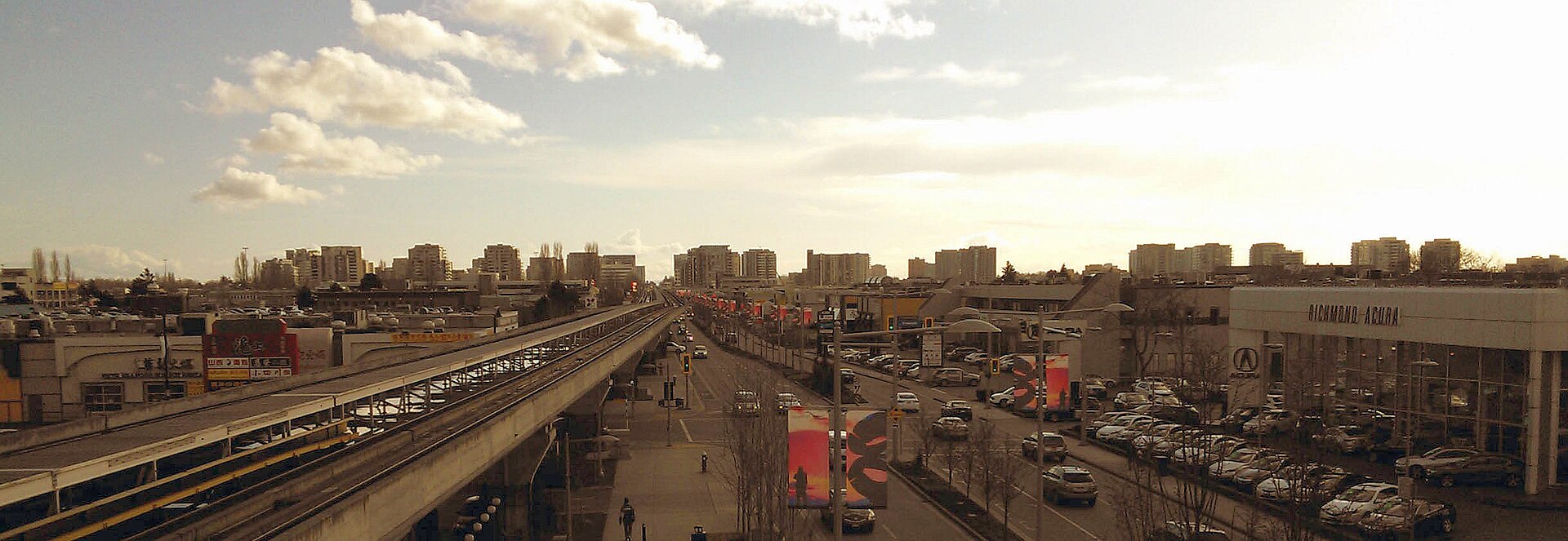
City Centre has absorbed a large volume of concrete high-rise over the past two decades, alongside an older body of low-rise stock elsewhere in the city. The towers concentrate the classic vertical risk — one suite failure, many suites affected — while the low-lying ground makes the bottom of any building the place where water accumulates rather than drains away.
Mechanical rooms, parkade levels and ground-floor amenity spaces are therefore worth protecting early. All three are common property, so none of that work waits on suite access.
Why councils here act
The cost of a water claim in Richmond is rarely confined to the affected suites. Equipment at the lowest level of a building — pumps, electrical, parkade services — is expensive to replace and slow to reinstate, and the loss of use compounds the direct damage.
As elsewhere in the province, councils are also responding to strata insurance that has become materially more expensive for buildings with a water history, and materially more negotiable for buildings that can document what they have installed.
How it goes in here
Licensed Richmond-area contractors do the installation. The usual sequence protects mechanical spaces and risers first, then amenity and ground-floor areas, then suites as owners come on board.
The gateway runs on a private LoRa network rather than on building Wi-Fi, which matters in a concrete tower where one wireless network rarely covers a parkade and a penthouse equally well.
Questions councils in Richmond ask
- Does the system cover the parkade and mechanical levels?
- Yes, and those are usually the first spaces protected. They are common property, so the work does not depend on suite access, and they hold the equipment that is most expensive to reinstate once water reaches it.
- Will the wireless signal reach the lower levels?
- The devices communicate over LoRa on a private encrypted network — a long-range, low-power radio that penetrates structure far better than Wi-Fi. It does not depend on the building’s internet, so an outage is not a monitoring outage.
- What happens if the valve closes and it turns out to be nothing?
- Thresholds are tuned to your building during commissioning, and, where the in-line flow sensor is fitted, detection is based on flow behaviour rather than a single wet contact. When something trips, the owner and management are alerted at the same time, and the valve can be reopened once the cause is confirmed.
Governance references on this page describe common practice under the BC Strata Property Act. They are general information rather than legal advice — your strata lawyer or property manager is the authority on what your building must do.
What gets installed
The same system goes into every building: an in-line flow sensor on the supply, wireless point-of-leak sensors in the wet zones, and an automatic shut-off valve that closes when something is wrong. It is set out in full on the home page, and every data sheet is on the downloads page. What changes from building to building is the sequencing, not the hardware.
Book a free building assessment
A specialist attends the building, walks the risers and mechanical rooms, and leaves a written recommendation your council can put in front of an owner meeting or a broker. No cost and no obligation.
Other service areas
Each page covers the building stock and the council questions particular to that city.